Quincunx Elastomer Jaw Coupling
Cushioned torsional connection using a star-shaped elastomer insert for servo auxiliaries, pumps, machine tools and compact gearmotor drives.
What this product is for
Quincunx Elastomer Jaw Coupling are presented here as a documented EVER POWER product/configuration family for buyers who need to connect rotating shafts while transmitting torque and, depending on design, accommodating limited misalignment or shock. The page does not infer an exact model from appearance alone. It turns the uploaded catalogue evidence into a practical RFQ path: identify the interface, describe the operating duty, and confirm the final drawing before production.
The most important decision is cushioned torsional connection using a star-shaped elastomer insert. For a useful quotation, buyers should select insert hardness, temperature range, chemical exposure, torque, speed and misalignment limit. These checks reduce the risk of ordering a component that looks similar but does not match the chain, belt, shaft, hub, vehicle or surrounding machine.
Five supported key facts
Connect rotating shafts while transmitting torque and, depending on design, accommodating limited misalignment or shock.
Cushioned torsional connection using a star-shaped elastomer insert.
Shaft bore, keyway, hub type, torque, speed, axial spacing, misalignment and elastomer or chain element.
Pumps, gearboxes, conveyors, mixers, machine tools and auxiliary drives that need serviceable shaft connection.
Overload, excessive misalignment, worn elastomer, loose fasteners, inadequate guarding and unsupported shaft loads.
Catalogue evidence
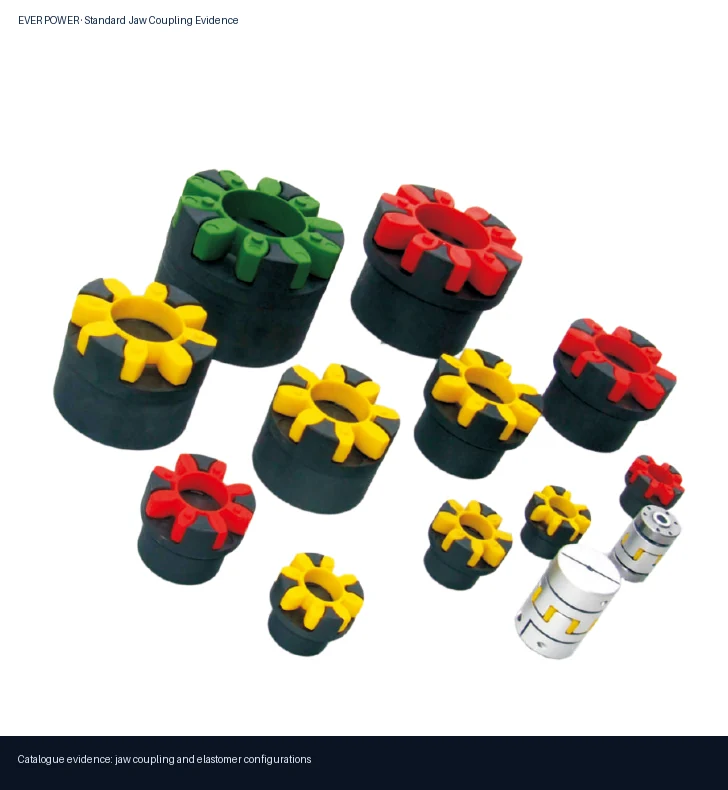
Source: Couplings catalogue, catalogue page reference 21. The crop preserves the product or technical geometry while excluding unrelated sample-company branding. Product names on this website are normalized to EVER POWER as requested.
Specification and RFQ variables
No unsupported dimensions are added to this page. Instead, the table records the variables that must be matched against the catalogue, a customer drawing or a verified sample.
| Variable | What to provide | Why it matters |
|---|---|---|
| Interface | Shaft bore, keyway, hub type, torque, speed, axial spacing, misalignment and elastomer or chain element | Defines whether the part physically mates with the shaft, chain, belt, flange, spline or vehicle assembly. |
| Operating duty | Speed, torque or load, start frequency, hours per day, environment and maintenance access | Separates a light replacement duty from a shock-loaded or high-cycle application. |
| Material and finish | Drawing requirement, corrosion exposure, heat treatment, hardness or coating where specified | Controls wear, corrosion resistance, machinability and inspection criteria. |
| Acceptance data | Critical tolerances, runout, balance, test report, marking and packaging | Turns a product description into measurable production and incoming-inspection requirements. |
Applications and duty conditions
Typical application areas include servo auxiliaries, pumps, machine tools and compact gearmotor drives. Application wording is contextual rather than a claim that every listed machine uses the same configuration. The final selection must account for the actual shaft arrangement, guard, lubrication access, ambient conditions, speed and peak loading.
In steady duty, the component can be evaluated around nominal power or torque. In repeated starts, reversing motion, impact loading or contamination, the engineer should apply a suitable service factor and inspect the connected components as one system. A stronger individual part cannot compensate for poor alignment, an undersized shaft, incorrect tension or a worn mating part.
Quincunx Elastomer Jaw Coupling engineering worksheet
This worksheet is specific to the quincunx elastomer jaw coupling page. It frames a capacity expansion around the documented selection focus: cushioned torsional connection using a star-shaped elastomer insert. The first action is to identify the mating geometry represented by shaft bore, keyway, hub type, torque, speed, axial spacing, misalignment and elastomer or chain element. The second is to inspect the operating evidence against select insert hardness, temperature range, chemical exposure, torque, speed and misalignment limit. A quotation should then document which values came from the catalogue, which came from the buyer and which still require a controlled drawing. Production is not confirm until those three evidence groups agree.
Application-by-application questions
For servo auxiliaries, ask how the driver starts, how often the machine reverses and whether the connected element can be isolated for service. For pumps, check contamination, access and the consequence of a jam. For machine tools, define the acceptable noise, vibration and temperature baseline. For compact gearmotor drives, document whether the part is a first installation, a like-for-like replacement or a redesign. These four contexts lead to different inspection priorities even when the visible component family is the same.
Interface acceptance plan
Use the phrase “Quincunx Elastomer Jaw Coupling interface” on the RFQ and attach a marked-up sketch. Number every dimension that controls assembly, then separate reference dimensions from acceptance dimensions. The acceptance list should cover shaft bore, keyway, hub type, torque, speed, axial spacing, misalignment and elastomer or chain element; it should also state datum choice, measuring method, temperature condition and whether the mating part is new or worn. Where the interface includes a bore, keyway, spline, flange, groove, tooth or joint, the buyer should identify the corresponding mating standard or provide the mating component for verification.
Duty review for this configuration
The documented duty context is pumps, gearboxes, conveyors, mixers, machine tools and auxiliary drives that need serviceable shaft connection. Build the duty statement from normal running, peak event and abnormal event. Normal running describes stable speed and load. The peak event covers starting, braking, reversing or momentary overload. The abnormal event covers blockage, impact, misalignment or lubricant loss. This separation prevents a nominal operating figure from hiding the condition that actually controls the quincunx elastomer jaw coupling selection.
Inspection and commissioning record
Before assembly, photograph the identification and inspect the surfaces connected to shaft bore, keyway, hub type, torque, speed, axial spacing, misalignment and elastomer or chain element. During the first controlled run, log speed, direction, temperature, sound and visible movement. Stop if the assembly shows the family-specific warning signs: overload, excessive misalignment, worn elastomer, loose fasteners, inadequate guarding and unsupported shaft loads. After the initial run, recheck fasteners, axial position, tension or alignment as applicable. Retain the measurements with the drawing revision and purchase order so a later replacement can be compared with the original accepted condition.
Product-specific spare and service logic
A spare should preserve the approved interface, not merely the general appearance of the quincunx elastomer jaw coupling. Store the companion parts that govern installation—such as keys, bushes, links, belts, elastomer elements, fasteners, guards or joint hardware—only when they are confirmed for this configuration. Label the spare with the buyer's equipment location, drawing revision and inspection status. When the dominant risk is overload, excessive misalignment, worn elastomer, loose fasteners, inadequate guarding and unsupported shaft loads, the maintenance plan should inspect the mating component at the same interval rather than treating the quincunx elastomer jaw coupling as an isolated item.
RFQ completeness test
An RFQ is ready for engineering review when it answers six questions: what exact interface must fit; what duty must be transmitted; what environment surrounds the component; what acceptance records are required; what quantity and destination apply; and what evidence authorizes production. For this page, the concise completeness test is: select insert hardness, temperature range, chemical exposure, torque, speed and misalignment limit. Missing answers are shown as open items in the quotation instead of being replaced by assumed dimensions or performance values.
Copy-ready RFQ data dictionary for Quincunx Elastomer Jaw Coupling
The field keys below are editorial RFQ labels, not model numbers or claimed specifications. They help buyers and EVER POWER exchange a complete, traceable data set without silently filling gaps.
| RFQ field key | Completion rule |
|---|---|
quincunx-elastomer-jaw-coupling-coupling-type | Enter the confirmed value for quincunx-elastomer-jaw-coupling-coupling-type and cite its source as catalogue, approved drawing, measured sample or buyer requirement. |
quincunx-elastomer-jaw-coupling-rated-torque | Enter the confirmed value for quincunx-elastomer-jaw-coupling-rated-torque and cite its source as catalogue, approved drawing, measured sample or buyer requirement. |
quincunx-elastomer-jaw-coupling-peak-torque | Enter the confirmed value for quincunx-elastomer-jaw-coupling-peak-torque and cite its source as catalogue, approved drawing, measured sample or buyer requirement. |
quincunx-elastomer-jaw-coupling-rotational-speed | Enter the confirmed value for quincunx-elastomer-jaw-coupling-rotational-speed and cite its source as catalogue, approved drawing, measured sample or buyer requirement. |
quincunx-elastomer-jaw-coupling-driver-shaft-diameter | Enter the confirmed value for quincunx-elastomer-jaw-coupling-driver-shaft-diameter and cite its source as catalogue, approved drawing, measured sample or buyer requirement. |
quincunx-elastomer-jaw-coupling-driven-shaft-diameter | Enter the confirmed value for quincunx-elastomer-jaw-coupling-driven-shaft-diameter and cite its source as catalogue, approved drawing, measured sample or buyer requirement. |
quincunx-elastomer-jaw-coupling-driver-bore | Enter the confirmed value for quincunx-elastomer-jaw-coupling-driver-bore and cite its source as catalogue, approved drawing, measured sample or buyer requirement. |
quincunx-elastomer-jaw-coupling-driven-bore | Enter the confirmed value for quincunx-elastomer-jaw-coupling-driven-bore and cite its source as catalogue, approved drawing, measured sample or buyer requirement. |
quincunx-elastomer-jaw-coupling-driver-keyway | Enter the confirmed value for quincunx-elastomer-jaw-coupling-driver-keyway and cite its source as catalogue, approved drawing, measured sample or buyer requirement. |
quincunx-elastomer-jaw-coupling-driven-keyway | Enter the confirmed value for quincunx-elastomer-jaw-coupling-driven-keyway and cite its source as catalogue, approved drawing, measured sample or buyer requirement. |
quincunx-elastomer-jaw-coupling-hub-length | Enter the confirmed value for quincunx-elastomer-jaw-coupling-hub-length and cite its source as catalogue, approved drawing, measured sample or buyer requirement. |
quincunx-elastomer-jaw-coupling-hub-outside-diameter | Enter the confirmed value for quincunx-elastomer-jaw-coupling-hub-outside-diameter and cite its source as catalogue, approved drawing, measured sample or buyer requirement. |
quincunx-elastomer-jaw-coupling-shaft-gap | Enter the confirmed value for quincunx-elastomer-jaw-coupling-shaft-gap and cite its source as catalogue, approved drawing, measured sample or buyer requirement. |
quincunx-elastomer-jaw-coupling-overall-length | Enter the confirmed value for quincunx-elastomer-jaw-coupling-overall-length and cite its source as catalogue, approved drawing, measured sample or buyer requirement. |
quincunx-elastomer-jaw-coupling-angular-misalignment | Enter the confirmed value for quincunx-elastomer-jaw-coupling-angular-misalignment and cite its source as catalogue, approved drawing, measured sample or buyer requirement. |
quincunx-elastomer-jaw-coupling-parallel-misalignment | Enter the confirmed value for quincunx-elastomer-jaw-coupling-parallel-misalignment and cite its source as catalogue, approved drawing, measured sample or buyer requirement. |
quincunx-elastomer-jaw-coupling-axial-movement | Enter the confirmed value for quincunx-elastomer-jaw-coupling-axial-movement and cite its source as catalogue, approved drawing, measured sample or buyer requirement. |
quincunx-elastomer-jaw-coupling-torsional-stiffness | Enter the confirmed value for quincunx-elastomer-jaw-coupling-torsional-stiffness and cite its source as catalogue, approved drawing, measured sample or buyer requirement. |
quincunx-elastomer-jaw-coupling-damping-need | Enter the confirmed value for quincunx-elastomer-jaw-coupling-damping-need and cite its source as catalogue, approved drawing, measured sample or buyer requirement. |
quincunx-elastomer-jaw-coupling-elastomer-grade | Enter the confirmed value for quincunx-elastomer-jaw-coupling-elastomer-grade and cite its source as catalogue, approved drawing, measured sample or buyer requirement. |
quincunx-elastomer-jaw-coupling-spider-size | Enter the confirmed value for quincunx-elastomer-jaw-coupling-spider-size and cite its source as catalogue, approved drawing, measured sample or buyer requirement. |
quincunx-elastomer-jaw-coupling-chain-size | Enter the confirmed value for quincunx-elastomer-jaw-coupling-chain-size and cite its source as catalogue, approved drawing, measured sample or buyer requirement. |
quincunx-elastomer-jaw-coupling-gear-tooth-form | Enter the confirmed value for quincunx-elastomer-jaw-coupling-gear-tooth-form and cite its source as catalogue, approved drawing, measured sample or buyer requirement. |
quincunx-elastomer-jaw-coupling-flange-pattern | Enter the confirmed value for quincunx-elastomer-jaw-coupling-flange-pattern and cite its source as catalogue, approved drawing, measured sample or buyer requirement. |
quincunx-elastomer-jaw-coupling-fastener-grade | Enter the confirmed value for quincunx-elastomer-jaw-coupling-fastener-grade and cite its source as catalogue, approved drawing, measured sample or buyer requirement. |
quincunx-elastomer-jaw-coupling-brake-drum-size | Enter the confirmed value for quincunx-elastomer-jaw-coupling-brake-drum-size and cite its source as catalogue, approved drawing, measured sample or buyer requirement. |
quincunx-elastomer-jaw-coupling-balance-grade | Enter the confirmed value for quincunx-elastomer-jaw-coupling-balance-grade and cite its source as catalogue, approved drawing, measured sample or buyer requirement. |
quincunx-elastomer-jaw-coupling-radial-runout | Enter the confirmed value for quincunx-elastomer-jaw-coupling-radial-runout and cite its source as catalogue, approved drawing, measured sample or buyer requirement. |
quincunx-elastomer-jaw-coupling-axial-runout | Enter the confirmed value for quincunx-elastomer-jaw-coupling-axial-runout and cite its source as catalogue, approved drawing, measured sample or buyer requirement. |
quincunx-elastomer-jaw-coupling-guard-envelope | Enter the confirmed value for quincunx-elastomer-jaw-coupling-guard-envelope and cite its source as catalogue, approved drawing, measured sample or buyer requirement. |
quincunx-elastomer-jaw-coupling-installation-torque | Enter the confirmed value for quincunx-elastomer-jaw-coupling-installation-torque and cite its source as catalogue, approved drawing, measured sample or buyer requirement. |
quincunx-elastomer-jaw-coupling-alignment-method | Enter the confirmed value for quincunx-elastomer-jaw-coupling-alignment-method and cite its source as catalogue, approved drawing, measured sample or buyer requirement. |
quincunx-elastomer-jaw-coupling-laser-alignment-target | Enter the confirmed value for quincunx-elastomer-jaw-coupling-laser-alignment-target and cite its source as catalogue, approved drawing, measured sample or buyer requirement. |
quincunx-elastomer-jaw-coupling-dial-indicator-target | Enter the confirmed value for quincunx-elastomer-jaw-coupling-dial-indicator-target and cite its source as catalogue, approved drawing, measured sample or buyer requirement. |
quincunx-elastomer-jaw-coupling-ambient-temperature | Enter the confirmed value for quincunx-elastomer-jaw-coupling-ambient-temperature and cite its source as catalogue, approved drawing, measured sample or buyer requirement. |
quincunx-elastomer-jaw-coupling-chemical-exposure | Enter the confirmed value for quincunx-elastomer-jaw-coupling-chemical-exposure and cite its source as catalogue, approved drawing, measured sample or buyer requirement. |
quincunx-elastomer-jaw-coupling-start-frequency | Enter the confirmed value for quincunx-elastomer-jaw-coupling-start-frequency and cite its source as catalogue, approved drawing, measured sample or buyer requirement. |
quincunx-elastomer-jaw-coupling-shock-load | Enter the confirmed value for quincunx-elastomer-jaw-coupling-shock-load and cite its source as catalogue, approved drawing, measured sample or buyer requirement. |
quincunx-elastomer-jaw-coupling-reversing-duty | Enter the confirmed value for quincunx-elastomer-jaw-coupling-reversing-duty and cite its source as catalogue, approved drawing, measured sample or buyer requirement. |
quincunx-elastomer-jaw-coupling-inspection-method | Enter the confirmed value for quincunx-elastomer-jaw-coupling-inspection-method and cite its source as catalogue, approved drawing, measured sample or buyer requirement. |
quincunx-elastomer-jaw-coupling-drawing-revision | Enter the confirmed value for quincunx-elastomer-jaw-coupling-drawing-revision and cite its source as catalogue, approved drawing, measured sample or buyer requirement. |
quincunx-elastomer-jaw-coupling-material-certificate | Enter the confirmed value for quincunx-elastomer-jaw-coupling-material-certificate and cite its source as catalogue, approved drawing, measured sample or buyer requirement. |
quincunx-elastomer-jaw-coupling-hardness-requirement | Enter the confirmed value for quincunx-elastomer-jaw-coupling-hardness-requirement and cite its source as catalogue, approved drawing, measured sample or buyer requirement. |
quincunx-elastomer-jaw-coupling-surface-coating | Enter the confirmed value for quincunx-elastomer-jaw-coupling-surface-coating and cite its source as catalogue, approved drawing, measured sample or buyer requirement. |
quincunx-elastomer-jaw-coupling-part-marking | Enter the confirmed value for quincunx-elastomer-jaw-coupling-part-marking and cite its source as catalogue, approved drawing, measured sample or buyer requirement. |
quincunx-elastomer-jaw-coupling-export-packaging | Enter the confirmed value for quincunx-elastomer-jaw-coupling-export-packaging and cite its source as catalogue, approved drawing, measured sample or buyer requirement. |
quincunx-elastomer-jaw-coupling-order-quantity | Enter the confirmed value for quincunx-elastomer-jaw-coupling-order-quantity and cite its source as catalogue, approved drawing, measured sample or buyer requirement. |
quincunx-elastomer-jaw-coupling-delivery-destination | Enter the confirmed value for quincunx-elastomer-jaw-coupling-delivery-destination and cite its source as catalogue, approved drawing, measured sample or buyer requirement. |
quincunx-elastomer-jaw-coupling-replacement-reference | Enter the confirmed value for quincunx-elastomer-jaw-coupling-replacement-reference and cite its source as catalogue, approved drawing, measured sample or buyer requirement. |
quincunx-elastomer-jaw-coupling-mating-equipment | Enter the confirmed value for quincunx-elastomer-jaw-coupling-mating-equipment and cite its source as catalogue, approved drawing, measured sample or buyer requirement. |
Integration and installation checks
Before installation, clean the mating surfaces and compare the delivered identification with the approved drawing or catalogue selection. Measure the shaft, bore, spline, flange, pitch, groove or joint interface rather than relying on a visual match. Confirm that keys, fasteners, bushes, chain links, belts, elastomers and guards are the intended companion parts.
- Check concentricity, axial position and alignment before applying full load.
- Use the specified fastener grade and tightening sequence; recheck after the first controlled run.
- Rotate the assembly by hand where safe, then test at low speed and observe noise, heat and vibration.
- Record the installation date and baseline condition so wear can be compared during maintenance.
Manufacturing and quality boundary
EVER POWER can support standard catalogue supply and custom manufacturing to customer drawings. Relevant processes may include forging or casting, turning, milling, hobbing, broaching, drilling, grinding, heat treatment, surface finishing and assembly, depending on the part. The exact route is product- and drawing-dependent.
For production orders, define the inspection characteristics that matter: material certificate, dimensional report, hardness, runout, tooth or groove geometry, balance, visual finish, packaging and traceability. The uploaded catalogues show broad product capability, but a catalogue-level certificate or company statement is not automatically a certificate for every individual configuration.
Maintenance and failure prevention
The dominant risks for this family are overload, excessive misalignment, worn elastomer, loose fasteners, inadequate guarding and unsupported shaft loads. A practical inspection should compare the current condition with the installed baseline and the mating parts. Look for fretting, cracking, corrosion, abnormal polishing, debris, lubricant loss, loosened fasteners, temperature rise or changes in noise and vibration.
Replace connected wear parts as a set when wear patterns are coupled. For example, a new chain on hook-worn sprockets, a new belt in damaged grooves, or a new elastomer between misaligned hubs may fail early. Maintenance intervals should be based on duty, environment and measured condition rather than a universal calendar claim.
Buying from Italy and global markets
For buyers in Italy and the European Union, quotations can be organized in metric dimensions with ISO/DIN/EN terminology where the source product supports it. For North American projects, ANSI and inch-series references are used when documented. Japan and other Asian OEM projects may require JIS or vehicle-specific references. The Reggio Emilia contact address supports commercial communication; the website does not claim local warehouses in other target markets.
Send a drawing, catalogue code, existing sample data or vehicle/OE reference to [email protected]. Include annual quantity, required inspection records, packaging, destination and target delivery window.
Frequently asked questions
Can EVER POWER manufacture a custom version?
Yes, custom production can be evaluated from an approved drawing or sufficiently complete sample data. Critical interfaces and acceptance criteria must be measurable.
Can I select from a photograph?
A photograph is helpful for orientation but not enough for final selection. Dimensions, pitch, spline, bore, flange, length or vehicle reference are required.
Are all standards and certifications shown in catalogues automatically applicable?
No. Standard, material and certificate requirements must be confirmed for the exact product and order. This page deliberately avoids unsupported blanket compliance claims.
Evidence boundary
This page is built from the uploaded Couplings catalogue, page 21, and contextual company/industry research. It does not publish unverified ratings, guaranteed life, price, stock, vehicle compatibility, customer reviews or certifications. Final dimensions and performance data belong in the approved quotation and drawing.